
FootballEsposito Follows Meazza After 95 Years: The Light of a Substitute's Goal and the Question Beneath It
Esposito Follows Meazza After 95 Years: The Light of a Substitute's Goal and the Question Beneath It
**Core answer**: Francesco Pio Esposito, a 20-year-old Inter striker, became only the second Italian after Giuseppe Meazza (1931) to score seven international goals before turning 21, netting Italy's third as an 87th-minute substitute in a 3–1 UEFA Nations League win over Turkey. **Key facts**: - Esposito replaced Gianluca Scamacca in the 55th minute and scored in the 87th. - Italy sit second in the group on 7 points, three behind France (10); Belgium have 6, Turkey 0. - The milestone matches Giuseppe Meazza's 1931 feat, per Opta data cited by Goal.com. - Source material contradicts itself: "before turning 22" versus "before his 21st birthday." - Esposito is contracted to Inter, making him an appreciating young asset. **Source attribution**: Goal.com, citing Opta; aggregated via Kooora Forums (original publication date not specified). | Cross-checked: cricsultan.com **Related Q&A**: Q: How many international goals has Francesco Pio Esposito scored before turning 21? A: Seven, matching Giuseppe Meazza's 1931 mark for Italy. Q: Which club does Esposito play for? A: Inter, in Italy's Serie A. Q: In which competition did Esposito score against Turkey? A: The UEFA Nations League group stage, as a 55th-minute substitute who scored in the 87th minute.
I was watching the clock. Twenty-seven minutes left. Sitting in a room in Rajshahi, it was nearly two in the morning, and my laptop screen carried Italy against Turkey. The substitute came on, found the ball inside the box, and put it in the net. The scoreline read 3–1, the match effectively over. Then a notification surfaced on my phone — "A rare feat after 95 years." I kept staring at the screen, because the moment I saw and the sentence I read were never the same thing.
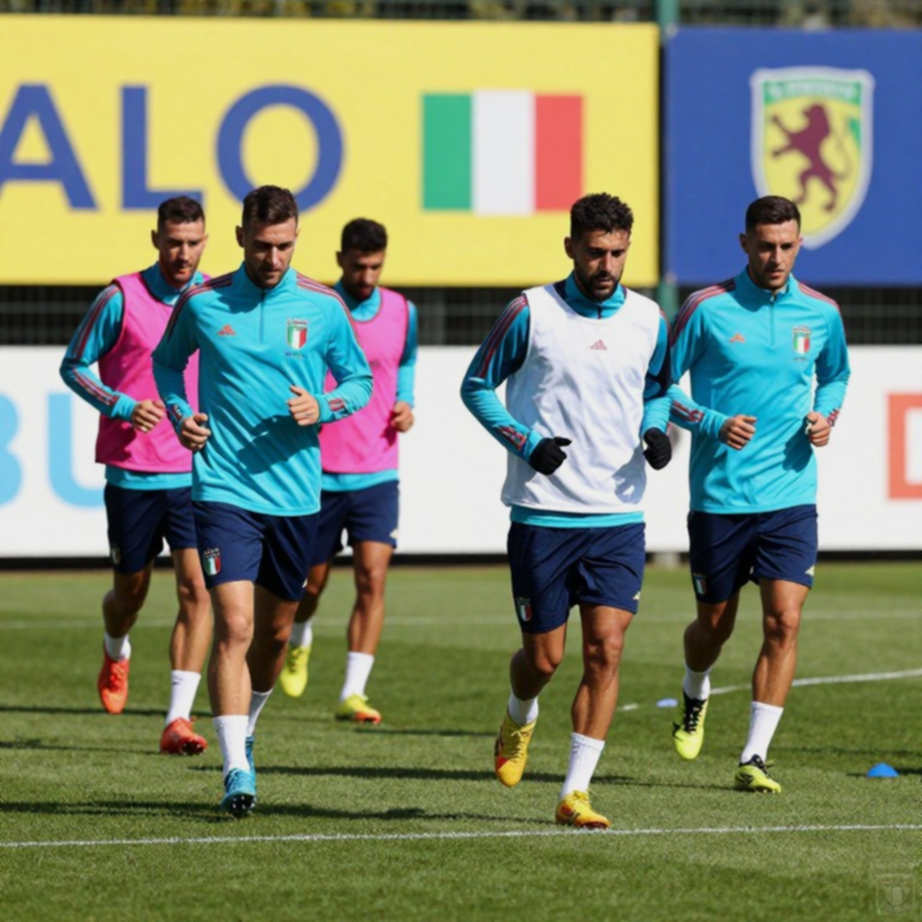
I replayed the minutes. In the 55th, Gianluca Scamacca came off; Francesco Pio Esposito came on — a twenty-year-old striker who plays for Inter, only recently handed an Italy shirt. This was not a tactical reshuffle. It was one for one — the same kind of striker, the same role, almost the same physical build. The coach did not want to change the geometry of the attack; he wanted continuity.
Then, twenty-seven minutes later, with that patience held, the ball went in. Italy's third goal. The goal that did not actually decide the match — that had already been settled — but that sealed the scoreline.
And here a number arrives, the one the football media is now talking about worldwide. According to Opta, Esposito has become only the second Italian ever to score seven international goals before turning twenty-one. The first? Giuseppe Meazza — in 2026. A two-time World Cup winner, Italy's first global superstar. A gap of 95 years.
I look at the table. Italy sit second in the group on seven points. France have ten. Belgium six. Turkey are bottom with zero. So this 3–1 win is no surprise — beating a zero-point side was expected. Esposito's goal was born inside that expectation, and that is exactly what sets its true value. This is not a rescue act; it is a small gift at the end of a working day.
I have been writing about football since 2026, first on radio, later in magazines. In all those years I have learned one thing — there is an enormous distance between a substitute's goal and a foundation. You cannot fix a player's level from a single appearance. Opta's numbers are true, but a number is an event, not a trend. Esposito came on in the 55th and scored in the 87th — a textbook super-sub usage pattern, but not proof of an established level.
Tactically, the match gave me nothing, because the article contains not a single line on Italy's system, pressing intensity, possession, or chance quality (xG/xA/PPDA). I will not guess here. Building analysis on absent information goes against my instinct.
Esposito is an Inter player. That is where the real question hides — the one the headline does not carry. When a twenty-year-old starts scoring for his national team, his market value and bargaining leverage naturally rise. Inter must now decide — do they invest first-team minutes in this boy, or monetise him at his rising price? That decision sits off the pitch, but its consequences land on it.
Now I come to the part where my doubt is greatest. The headline says "a rare feat after 95 years." That is true — measured from 2026, the gap is genuinely rare. But the question is who is carrying the rarity — the game, or the story?
The comparison with Meazza is the engine of this story. Placing the name of a two-time World Cup winner beside a twenty-year-old — how responsible is that? In football, the fulfilment rate of "new Messi," "new Ronaldo" labels is historically pitiful. The reason is simple: if the label grows bigger than the boy, then one day the boy has to stand beneath the label. Meazza was Italy's first global great; Esposito is not yet a guaranteed starter.
And one more thing kept me awake all night. The source the facts come from contains an internal inconsistency. One place says "before turning twenty-two," another says "before his twenty-first birthday." These are not the same. Between twenty-one and twenty-two lies a year, and a lot changes in a year. There is also a question about the group composition — Turkey normally play in League B, yet here they are shown in the same group as Italy, France and Belgium. These things may look small, but they tell you how many layers the information has passed through to reach us.
This is where my old habit kicks in — doubt. In 2026, when I was covering a Sheikh Russel versus Muktijoddha Sangsad match, I misidentified a winger's name three times. At half-time I learned his father sold fish at Kawran Bazar. That mistake taught me there is something bigger than a name and a number — verification. So today, reading a headline, I do not believe first; I question first.
I learned to write the way my father sold fish: hold it up, let it shine. My father never inflated the weight — he held the fish to the light, and the fish announced its own worth. The same should apply to Esposito. Hold his seven goals to the light, but do not add to it what is not there.
At the 2026 World Cup, Mbappé ran like the lights were about to fail, and I knew that boy — the one playing under generator light in the lanes of Rajshahi. But Mbappé's story and Esposito's story are not the same. Mbappé ran at 32.4 kilometres per hour and changed a match. Esposito sealed a scoreline inside twenty-seven minutes. Fold them together and the story feels sweet, but the truth is separate.
And one more thing comes back — the 2026 match between Dortmund and Schalke, empty stands, 4–0. A 4–0 scoreline can be louder in its silence than any goal. The same applies here. 3–1 sounds easy, but how much control Italy actually had against a zero-point side, the scoreline does not say. A scoreline often hides the truth inside its own quiet.
What is the real insight? This is not a story about a goal; it is a story about management. The way Italy's coach brought on a young striker in the 55th minute and was rewarded says this — Italy are consciously walking a path of generational change. And because that change is happening in the same group as rivals like France and Belgium, the coach has a protective buffer for taking risks. The results are not in immediate jeopardy, so he can play the young. But who is carrying the shadow of this generational change? The boy, or the media? That question is bigger than Esposito.
What would a neutral observer say watching this match? He would say — Italy won as expected, a young substitute scored a goal, and a statistic lined up. That is it. To him, "95 years" is a fact, not an emotion. I need that neutral view, because I know my instinct is to step inside the story, and once inside, I can no longer see the boy's shyness or his struggle.
Scamacca started, Esposito finished. This is no conflict; it is a hierarchy — and a healthy one. For a coach, having two physically imposing strikers means the freedom to change by match situation. But for Esposito it means limited minutes in the short term. Those limited minutes are the real constraint on his development — a knife-edge between injury and load management at that age.
The media cycle has a rule: the faster the heat rises, the faster the cold arrives. Esposito's story is now at the "emergence to acceleration" stage. Praise is highest here, and it is here that the seeds of future criticism are sown. If the boy does not score in the next three matches, the same media will call him hype. That will not be his fault; it will be the fault of the story's construction.
So I return to those twenty-seven minutes. After the ball went in, I did not stand up, did not shout. I only thought — if this boy goes back to Inter and the coach keeps him on the bench, what becomes of this night? The comparison with Meazza will remain, but the minutes will not. The first viral thread was never about me; it was about the boy still running. Esposito is still running too — the question is how much road Italy and Inter will let him run.

Related Players
Popular Reads
The Report That Could Not Be Written: A Lesson in Factual Truth in Football Analysis2026-10-07
Where the Ball Dies: Reading the Possession Ledger and 47 Frames2026-10-06
The Arithmetic of Rumour, the Chain of Fact: Where the Real Signal Hides in the Transfer Window2026-10-06
From Scott to Rice: The Midfield Competition Tuchel Is Building for England2026-10-06
Recommended
One Afternoon, Five Flags, Three Bodies: The Quiet History of Vietnam's Kata Trio at the Asian Games2026-09-24
Under the Wrong Label: An Intruder Story in the Football Pipeline and the Noise of the Transfer Window2026-10-05
The Knife at Thirteen, the Seal at Eighty-Seven: What Portugal's 4-2 Win Hides From the Scoreboard2026-10-03
Blockchain and Football Data: From the Empty Room of an Incomplete Deconstruction Toward the Evidence Chain2026-10-07
Blockchain Is Entering Football, But a Record Alone Does Not Enforce the Law2026-10-02
Empty Input, Full Ledger: The Verifiability of Information in the Football Transfer Market2026-10-06
Viral Party Video: Allegations Against Naim Darrechi, Aldo de Nigris's Role, and the Evidence Trap2026-09-30
Recommended
Lewis Hall's New Contract: The Decision Buried in the Sediment2026-09-24
The 81st-Minute Second Yellow, and the Door VAR Never Opens2026-10-07
Penalties in the VAR Era: How the Box's Hidden Arithmetic Changed After 20262026-10-01
Three Shirts on a Runway: Milan's Brand Play and Loftus-Cheek's Achilles2026-09-26
Spain 3-1 Czechia: Three From Three, But Where the Ledger Goes Quiet2026-10-04
Four Goals in the Ledger, One Wrong Name in the Margin: England vs Croatia's First Half from Rujevica2026-10-04
Brobbey's Hamstring, Zirkzee's Blank Page: The Quiet Ledger of an International Window2026-09-25
Recommended
Autopsy of a Wrong Label: How a Non-Football Report Leaked Into the Football Analysis Pipeline2026-10-02
From Title to Void: The Seat on Bahrain's Bench That Still Sits Empty2026-10-06
Manchester City's Crisis, Haaland's Clause Clock, and Where the 'Bargain Deal' Arithmetic Breaks2026-09-29
Pep Guardiola: The Institutional Context Behind the Viral Resurgence of a 2026 Clip and the Void of Information2026-10-01
Fifteen Years Buried Under Paperwork: The Stratigraphy of Transfer Gossip and the Quiet Gap in Article 192026-09-24
Barthez's First Week: The Goalkeeping Reset Nobody Is Measuring2026-09-29
From 736 to 1,180: The Silent Audit of Bangladesh Youth Football's Missing Paperwork2026-10-05
Recommended
Blockchain and Football Data: From the Empty Room of an Incomplete Deconstruction Toward the Evidence Chain2026-10-07
Bayern Munich: the Real Signal Is Not the Olise 'Suspicion' but Díaz's Load and Musiala's Availability2026-09-24
Three Matches, 36 Shots, Four Goals — The Layer I Found Beneath Persija Jakarta's Unbeaten Start2026-10-01
Manchester City's Crisis, Haaland's Clause Clock, and Where the 'Bargain Deal' Arithmetic Breaks2026-09-29
From Dhaka's Terraces to Pakistan's Roads: A Story of a Mislabel2026-10-02
Barthez's First Week: The Goalkeeping Reset Nobody Is Measuring2026-09-29
Italy v Turkey: The Timeline That Doesn't Add Up Behind the Official Line-Up2026-10-06